April 18, 2026 • Maren Solvik • 9 min reading time • Specs verified June 11, 2026
Bag Seeders and Shoulder Spreaders: Honest Comparison for Lawn Overseeding and Garden Bed Broadcasting
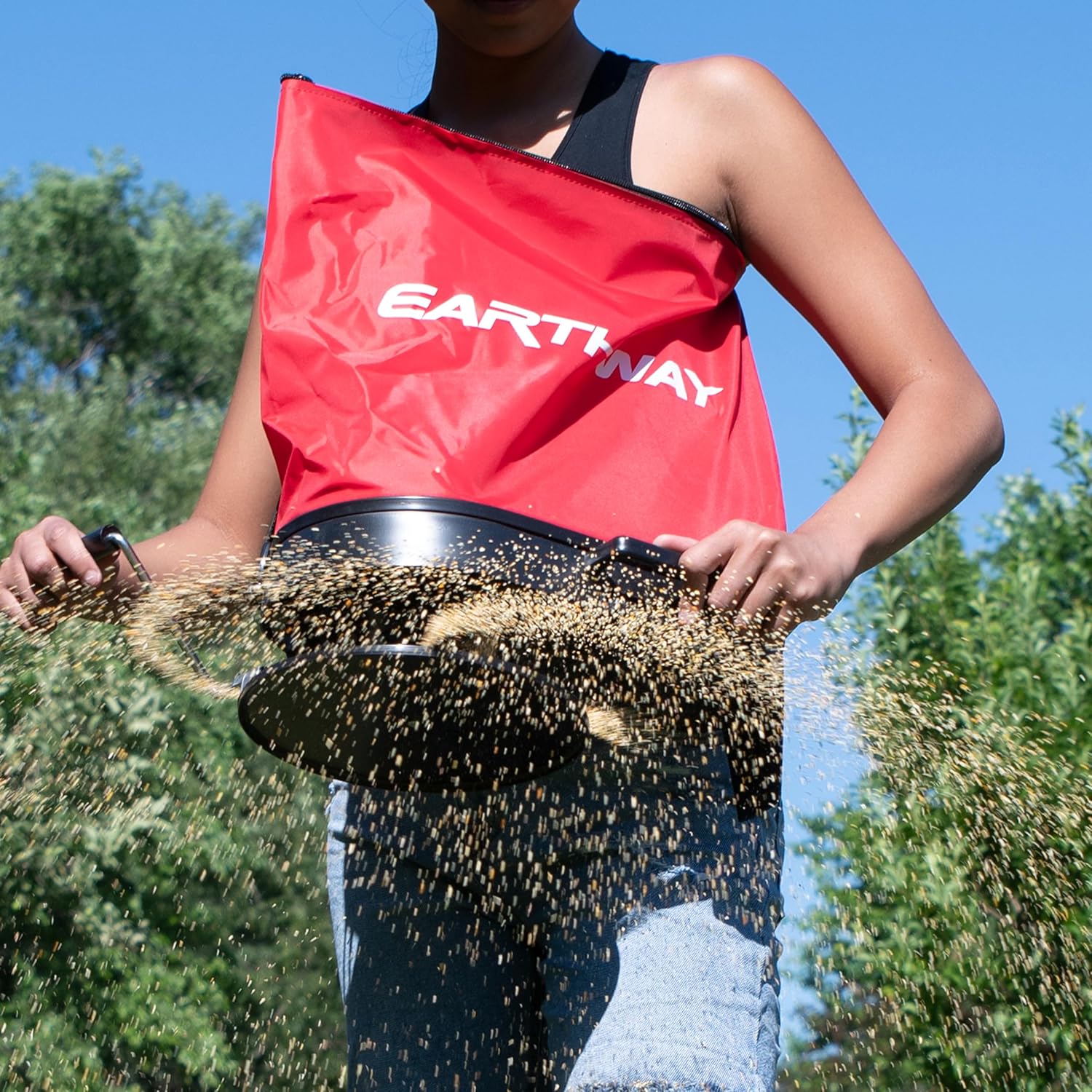
If you’ve ever shaken grass seed out of a coffee can over a patchy lawn, or scattered wildflower mix across a raised bed by hand, you already understand the core problem with broadcasting seed — spreading it loosely across a surface rather than placing it one-by-one in a furrow: coverage is uneven, your arm tires fast, and you genuinely cannot tell whether you’ve hit the right seeding rate until it’s too late to fix it. Broadcast seeders solve this by metering seed through a spinning or gravity-fed mechanism, giving you consistent coverage at a dialed-in rate. The question this article answers is which kind of broadcast seeder — a bag-style hand seeder you carry at your side, or a shoulder-strap spreader you wear like a messenger bag — actually fits your job. We’ll name the tradeoffs plainly, show the math where it matters, and close with a clear decision rule organized by budget tier so you can act on the comparison immediately.
| EDITOR'S PICK[EarthWay 2750 25lb Nylon Bag Se…](https://www.amazon.com/dp/B000XS3EHA?tag=greenflower20-20) | Mid-tier[Yard Tuff Outdoor Lawn Garden 2…](https://www.amazon.com/dp/B00CQLAJ8E?tag=greenflower20-20) | Budget pick[Agri-Fab Handheld Bag Seeder Sp…](https://www.amazon.com/dp/B0DMN4DZZN?tag=greenflower20-20) | |
|---|---|---|---|
| Material | Nylon | Canvas | Waterproof Zipper |
| Strap Type | Cross shoulder | Shoulder strap | Adjustable shoulder |
| Side Spread Control | ✓ | — | — |
| Rear Baffle | — | — | ✓ |
| Close Shutoff | Spring close | — | — |
| Price | $59.99 | $46.49 | $34.23 |
| See on Amazon → | See on Amazon → | See on Amazon → |
What “Bag Seeder” and “Shoulder Spreader” Actually Mean
The terminology in this product category is looser than it should be, so let’s fix that before going further.
Bag seeders (sometimes called hand-crank spreaders or belly spreaders) are relatively compact hoppers — typically 5 to 20 pounds of seed capacity — with a hand-operated or battery-assisted spinning impeller, the fan-like disc that flings seed outward. You hold them in front of you or at your side by a handle. Common examples in the $40–$120 range are sold at most garden centers alongside grass seed bags and are the default starter tool for homeowners doing occasional patch repair.
Shoulder spreaders (also called chest spreaders or strap spreaders) add a carrying harness that distributes weight across your shoulder or chest. They typically hold 15–50 pounds and are powered by a hand crank or a small battery motor. The strap fundamentally changes the ergonomic equation and, as we’ll get into, has real implications for serious lawn and garden work.
There’s also a meaningful distinction between broadcast spreading — wide, fan-shaped distribution, typically 4–15 feet wide — and the precision row seeding that tools like the Jang JP-1 or Earthway 1001-B perform. This article covers broadcast tools only. If your primary goal is precise in-row spacing for vegetable beds, those push-seeder comparisons are covered in the site’s dedicated row-seeder guides. The tools here are the right fit for lawns, cover crops, wildflower meadows, and bed-scale broadcasting where exact seed-to-seed spacing isn’t the priority.
The Core Tradeoff: Weight, Fatigue, and Coverage Width
Here is where practitioners often get this wrong: they optimize for price or hopper size and underweight the ergonomic cost over a real working session.
Penn State Extension, in their publication Lawn Establishment and Renovation, notes that overseeding a typical residential lawn of 3,000–5,000 square feet at recommended rates — roughly 6–8 lbs of Kentucky bluegrass per 1,000 sq ft, or 8–10 lbs of tall fescue — means moving 20–50 pounds of seed total across the area, often in two perpendicular passes. That weight math matters when you’re choosing a carrying format.
With a bag seeder held by hand, you’re typically supporting 3–8 pounds of loaded weight with one arm while cranking with the other. For small jobs — a 500 sq ft raised-bed area, a patch of bare lawn, a cover-crop strip in a market garden plot — this is perfectly fine and more maneuverable than a larger tool. The lighter footprint lets you work close to bed edges, around obstacles, and between rows without overshooting.
With a shoulder spreader, that same weight transfers to your torso. The strap converts what would be arm fatigue into a sustainable walking load — comparable to wearing a daypack. The practical payoff: you can work longer before breaking, maintain a more consistent walking speed (which directly affects distribution evenness), and reload less often thanks to larger hopper capacity.
University of Minnesota Extension, in their guide Overseeding Lawns, recommends two perpendicular passes for uniform coverage — a protocol that assumes you’ll maintain consistent walking speed throughout. Fatigue-induced pace variation is one of the most common causes of streaky coverage, and the shoulder strap is a direct counter to that problem.
Coverage width is the other axis. Most hand bag seeders throw 4–8 feet. Most shoulder spreaders reach 8–15 feet depending on impeller speed and dial setting. For a 2,000 sq ft lawn, a narrower throw means more passes — more time, more route overlap to manage.
By the numbers:
- 2,000 sq ft lawn | 6-ft throw width | ~333 linear feet of passes needed
- 2,000 sq ft lawn | 12-ft throw width | ~167 linear feet of passes needed
- At a comfortable walking pace of 3 mph, that’s roughly 1.4 minutes vs. 0.7 minutes of active spreading, not counting turns and reloads
For a single lawn, this feels trivial. Across a market garden with multiple cover-crop panels or a CSA farm doing seasonal renovation of multiple beds, halving your pass count compounds quickly into real time and labor savings.
Rate Accuracy: Calibration and Consistency
ATTRA/NCAT, in their publication Market Garden Tools and Equipment Overview, points out that broadcast spreader accuracy degrades in two predictable ways: inconsistent crank speed and inconsistent walking speed. A shoulder spreader addresses the second variable by stabilizing your body mechanics. Your hands are freed from supporting weight, so crank cadence becomes easier to keep regular.
Fine Gardening, in their coverage of broadcast seeding technique, notes that the gold standard for checking your actual delivery rate is to weigh seed before and after a measured test pass — not to trust the rate dial alone. Both bag and shoulder seeders have imperfect calibration dials, and they’re affected by seed shape, size, and moisture content in different ways. Grass seed behaves differently from wildflower mix, which behaves differently from crimson clover or buckwheat cover crop.
Where this matters for practitioners: if you’re seeding multiple species or switching between fine-seeded and coarse-seeded varieties across a session — common in a CSA or cut-flower context — a shoulder spreader with wider impeller speed adjustment and a more stable carrying position gives you better feedback. You can walk a test strip, count passes, and dial in your rate more reliably.
Johnny’s Selected Seeds, in their Seeding Equipment Guide, recommends calibrating any broadcast tool before each significant seed-type change, weighing seed output over a 100 sq ft test area. That’s good practice regardless of tool type, but practically easier when you’re not also managing hand fatigue from supporting a loaded hopper.
Tier-by-Tier Comparison: Which Tool Fits Which Operation
The following three tiers reflect both price and operational scale. Each closes with a pick marker so the site renderer can surface the right product for your situation.
H3: Budget Tier — Hand Bag Seeders for Occasional Homeowner Use
Best for: Lawns under 2,000 sq ft, raised-bed broadcasting, once-or-twice-a-season overseeding, storage-constrained urban gardens.
At the $30–$80 price point, a manual-crank hand bag seeder covers the needs of most homeowners doing annual lawn touch-up or spring bed prep. Hopper capacity runs 5–10 lbs — enough for a modest backyard without reloading. The throw width of 4–8 feet is a liability on open turf but an asset around raised beds and densely planted areas where you need to angle seed inward and avoid overshooting pathways.
Battery-assisted versions in the $60–$120 range reduce crank fatigue for longer sessions without adding meaningful size. For standard grass seed over flat terrain, the accuracy difference between manual and battery is minor. The honest limitation: for anything over 2,000 sq ft, you’ll feel the arm load by the second pass.
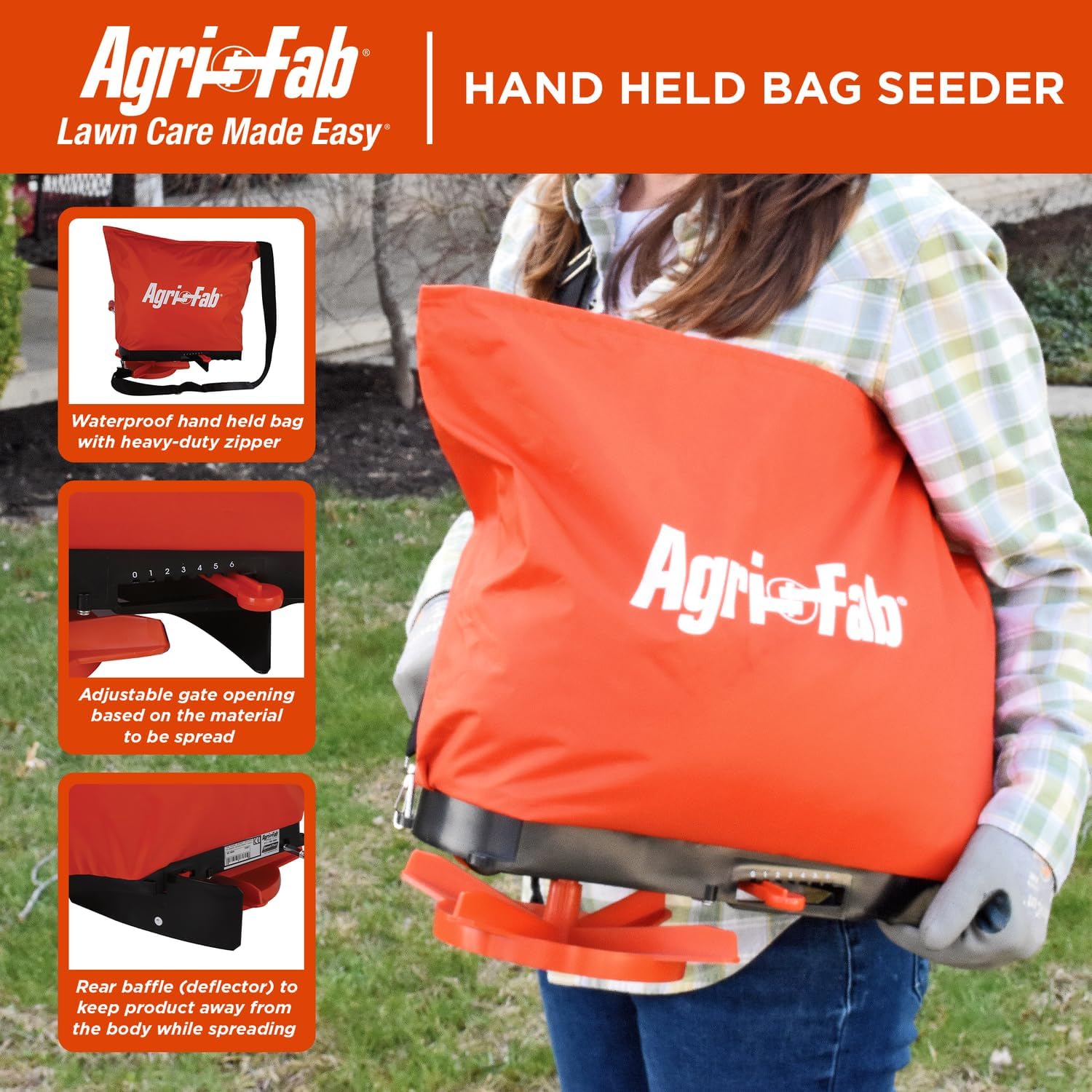
Agri-Fab
$34.23
In stock on Amazon
Check price on AmazonH3: Mid-Tier — Manual Shoulder Spreaders for Regular Lawn and Cover-Crop Work
Best for: Lawns of 2,000–8,000 sq ft, market garden cover cropping, two or more overseeding sessions per year, operators who’ve noticed fatigue-driven streaky coverage.
Manual shoulder spreaders in the $90–$160 range offer 15–35 lb hopper capacity and 8–12 ft throw width. The strap is the defining feature: it moves the load off your arm and onto your torso, letting you maintain the consistent walking pace that University of Minnesota Extension’s Overseeding Lawns guide identifies as essential for even coverage across two perpendicular passes.
Calibration is still a hands-on process — weigh your test strip as Johnny’s Selected Seeds recommends — but the stable carry position makes it easier to hold crank speed steady. For operators doing seasonal cover cropping across several market garden beds, the reduced pass count and longer working endurance before fatigue pay back the price step within a single season of heavy use.
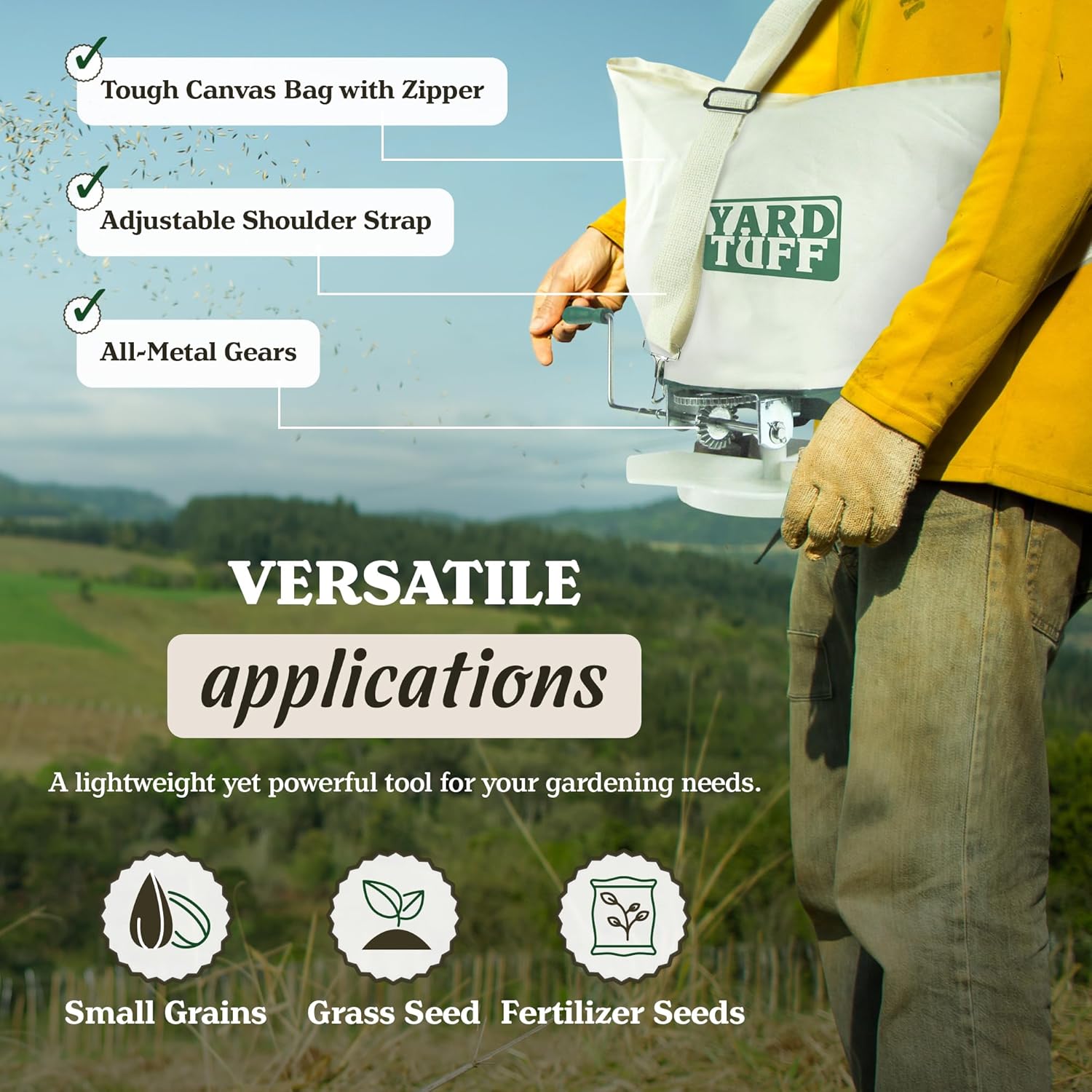
Yard
$46.49
In stock on Amazon
Check price on AmazonH3: Premium Tier — Battery-Assisted Shoulder Spreaders for CSA and Multi-Bed Operations
Best for: CSA farms, cut-flower operations, properties over 8,000 sq ft, multi-species seeding sessions, operators switching frequently between fine and coarse seeds.
Battery-assisted shoulder spreaders in the $140–$280 range add motorized impeller consistency on top of the ergonomic benefits of the strap design. Hopper capacity reaches 20–50 lbs. The motorized impeller is most meaningful for mixed-species jobs: wildflower blends, cover-crop cocktails, or any session where seed density and shape vary significantly between fills. Fine Gardening’s broadcast seeding guidance and ATTRA/NCAT’s equipment overview both point to impeller consistency as the primary accuracy variable, and a battery motor removes the human crank-speed variation from that equation.
For a CSA or cut-flower operation doing regular bed renovation and winter cover cropping across significant acreage, the break-even on seed savings from improved accuracy and reduced waste typically arrives within one to two seasons. The larger hopper also means fewer mid-field reloads — a practical time saving that compounds across a full growing calendar.
EarthWay
$59.99
In stock on Amazon
Check price on AmazonThe Decision Rule
Here’s the plaintext version of everything above, condensed into an if/then frame:
If your broadcast area is under 2,000 sq ft, you’re working around raised beds or obstacles, you store tools in tight quarters, or you seed once or twice a season — then a quality hand bag seeder in the $50–$100 range is the practical answer. You’ll get consistent enough results for the job without being over-tooled.
If your broadcast area regularly exceeds 2,000 sq ft, you’re doing multi-species cover cropping across a market garden, you run more than two overseeding sessions per year, or you’ve noticed fatigue-driven streakiness in your coverage — then a manual shoulder spreader with a 20+ lb hopper and stable strap system is worth the price step. The ergonomic difference shows up in coverage quality, not just comfort.
If you’re a CSA or cut-flower operation doing regular bed renovation or winter cover cropping across significant acreage, the battery-assisted shoulder spreader tier starts making break-even sense within one or two seasons of seed savings from improved accuracy and reduced waste.
The one thing both tool types share: neither replaces proper calibration. Weigh before, measure your test strip, and dial in your rate — exactly as Penn State Extension’s Lawn Establishment and Renovation guidance and Johnny’s Selected Seeds’ Seeding Equipment Guide both recommend. The spreader is the delivery mechanism. The discipline around calibration is what makes broadcast seeding predictable rather than approximate.