May 29, 2026 • Maren Solvik • 9 min reading time • Specs verified June 11, 2026
Hand-Push Seeders for Corn, Beans, and Peanuts: Matching Nozzle Count to Your Row Layout
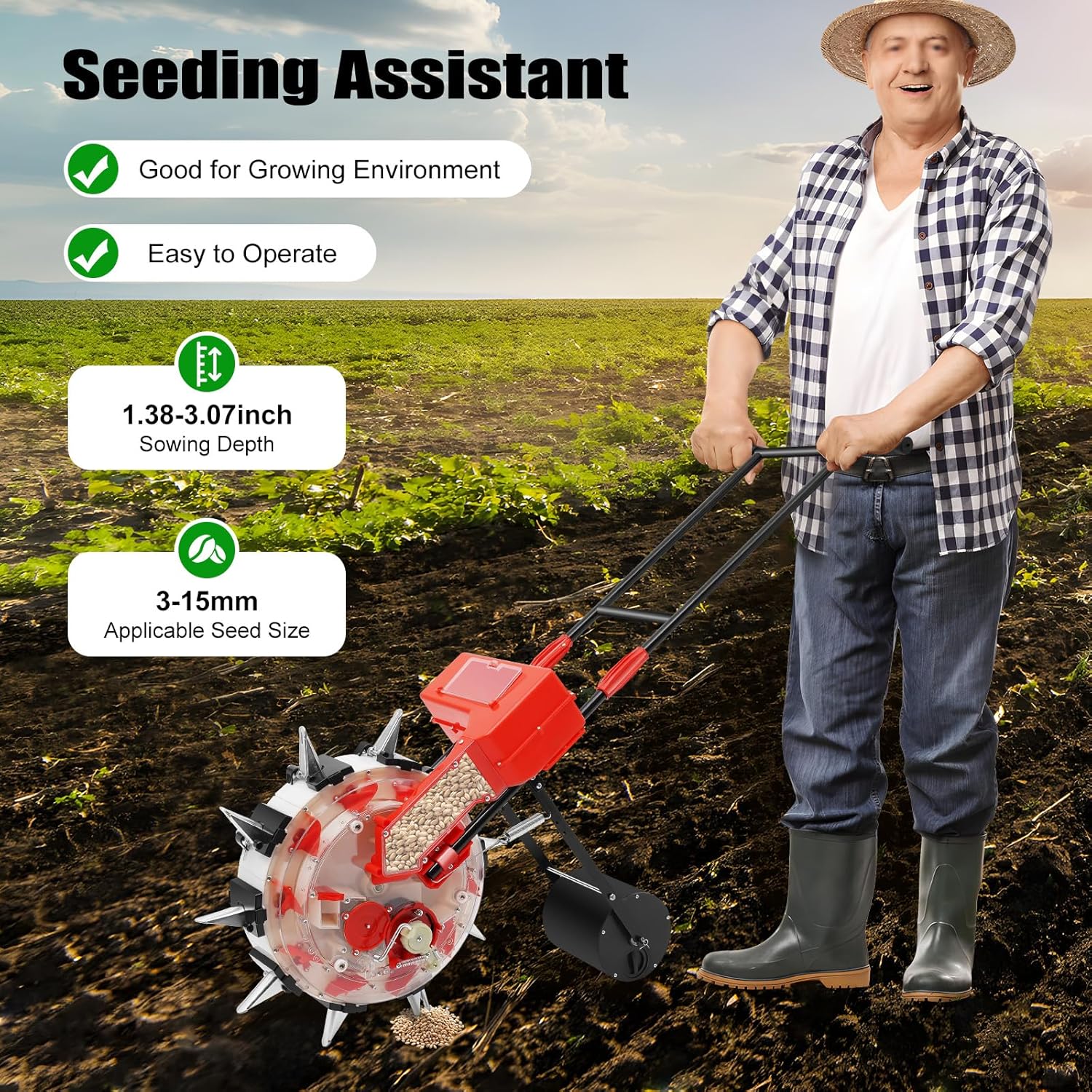
If you’ve ever knelt in a row and hand-dropped corn seeds one by one, you already know why people buy push seeders. A push seeder — sometimes called a walk-behind planter or row seeder — is a wheeled tool you walk down a garden bed while a mechanical system picks up individual seeds and drops them into the soil at a set interval. The wheel turns, a seed plate or belt rotates, and each seed falls through a nozzle (the tube or chute that delivers the seed to the furrow) at a spacing you’ve dialed in ahead of time. For large-seed crops like corn, dry beans, and peanuts, the right seeder eliminates the tedium of hand-placing and gives you consistent spacing that directly affects yield. This guide is for growers who’ve moved past basic seed-starting and are ready to match specific tool configurations — plate size, nozzle count, and row layout — to the crops they actually grow.
Why Large Seeds Break the Rules That Work for Carrots
Most precision seeder guides are written around tiny seeds — lettuce, carrots, brassicas — because those are the crops where seed cost and thinning labor make precision most obviously valuable. But corn, dry beans, pole beans, and peanuts present a different set of mechanical demands, and the tools that shine on fine seeds often fall apart here.
Seed diameter matters to the mechanism. Standard corn kernels run roughly 9–13 mm in their longest dimension; dry beans (depending on variety) land between 8–14 mm; peanuts in-shell are obviously oversized and are almost always shelled to 10–16 mm kernels before planting. These dimensions put immediate pressure on seed cells — the pockets in a plate or belt that pick up and carry one seed at a time. A plate sized for radish will bridge or skip entirely on a large bean. A plate designed for sweet corn may double-feed with a smaller flint corn variety.
The ATTRA/NCAT publication Direct Seeding Vegetable Crops: Equipment and Practice makes the point plainly: large-seeded legumes and corn require seed cells that match the seed’s actual bulk, and skipping plate verification is the single most common cause of erratic spacing in the field. The fix isn’t clever — it’s just checking the plate spec against the seed you’re actually planting that season, because even the same crop variety changes in size year to year depending on grower and storage conditions.
In-row spacing targets differ by crop. Sweet corn in a home garden typically wants 8–12 inches between seeds in-row, with rows 24–36 inches apart. Dry beans and snap beans range from 3–6 inches in-row in intensive raised beds to 6–9 inches in traditional row culture. Peanuts generally want 6–8 inches in-row. Each of these targets affects which drive ratio or plate hole count you need from a given seeder model — the two levers that let you change spacing without buying a new machine.
The Single-Nozzle vs. Multi-Nozzle Decision
Here’s where intermediate growers often stall: should you buy a single-row push seeder and make multiple passes, or invest in a multi-row tool and do it in one pass?
The honest answer depends on three things: your bed width, your total annual row footage, and your tolerance for alignment error across passes.
Single-row seeders (one nozzle)
The Earth-Way 1001-B is the most widely discussed single-row push seeder in this size and price range, and for large seeds it’s frequently cited in Growing for Market equipment roundups as a serviceable entry point. Its seed plates are interchangeable, and the dedicated corn plate (typically labeled for seeds in the 8–12 mm range) and bean plate are sold separately. Spec sheets put the 1001-B’s seed disc options at roughly a dozen standard configurations, and the corn/bean plates are among the most reliably available. At a 2026 street price around $90–$110, the break-even math is straightforward for anyone planting more than a few hundred row-feet of corn or beans annually: a single missed stand caused by hand-dropping can cost more in replanting time than the machine costs.
The practical limitation of single-row tools is exactly what the name implies — one pass per row. On a standard 30-inch raised bed where you’re running two rows of beans, you make two passes and rely on your eye or a string line to keep them parallel. Across a 1,000-square-foot garden plot this is manageable. Across a quarter-acre market plot, it compounds alignment error and doubles your pass count.
Multi-row seeders (two or more nozzles)
Multi-nozzle configurations — whether that’s a toolbar-mounted dual-row setup or a dedicated two-row push seeder — become practical once you’re running 50-foot beds at scale or managing a CSA plot where corn or dry beans occupy a meaningful share of your production space. The Hoss Garden Seeder is frequently cited in practitioner-level discussions as a single-row tool, but Hoss and comparable manufacturers sell toolbar extensions that let you mount two seeder units at a fixed center-to-center spacing. Growing for Market’s walk-behind planter coverage notes that two-row setups roughly halve planting time on large plots, which matters when you’re timing corn succession plantings around market dates.
The tradeoff: multi-row setups are heavier, require more careful pre-planting bed prep (both furrows need to be clean simultaneously), and cost roughly 1.8–2.5× as much as a single-row equivalent once you factor in the toolbar and second seed unit. They also commit you to a fixed row spacing — you can’t easily adjust from 24-inch to 30-inch rows without repositioning the mounting hardware.
By the numbers — rough cost and row-footage thresholds:
| Configuration | Approximate 2026 Cost | Sweet Spot (annual row-feet) |
|---|---|---|
| Single-row push seeder (e.g., Earth-Way 1001-B) | $90–$120 | 200–2,000 ft |
| Single-row with spare plates (corn + bean) | $110–$145 | 200–2,000 ft |
| Two-row toolbar setup | $250–$450 | 1,500–8,000 ft |
| Jang JP-1 with large-seed rollers | $300–$380 | 500–5,000 ft |
Plate and Roller Matching: The Step Most Buyers Skip
Buying the right seeder body is only half the decision. The seed-metering component — whether a flat disc with holes (Earth-Way style), a rubber seed belt (Jang JP-1 style), or a spiked or cupped roller — has to physically match your seed’s dimensions. This is where growers who’ve outgrown the basics often discover they’ve been running the wrong setup for a season.
Earth-Way plate system. The 1001-B uses flat circular seed discs with holes of varying diameter. The corn disc uses larger holes spaced to drop seeds at a fixed interval determined by wheel rotation. Johnny’s Selected Seeds’ seeder comparison resources note that the Earth-Way large-seed plates work well for standard sweet corn but can bridge (two seeds trying to exit at once) with jumbo-kernel varieties or large runner-type beans. The fix is to test-drop seeds on a flat surface before committing to a full row — rotate the disc manually and count actual drop frequency against expected. If you’re seeing doubles, move to the next plate size down.
Jang JP-1 roller system. The Jang uses a foam or rubber roller with finger-like protrusions that pick seeds from a hopper. The JP-1 roller chart — a document Jang distributes and that Johnny’s Seeds reproduces in their seeder guides — lists roller designations (e.g., YYM-10, EXP-16) matched to seed sizes in millimeters and approximate spacings. For corn, the most commonly cited configurations in practitioner reviews land on rollers in the YYM or X-series range depending on kernel size. ATTRA’s direct seeding publication flags the Jang as well-suited to beans and corn once the correct roller is identified, but notes the learning curve on roller selection as a real barrier for first-time users. The honest framing: the Jang JP-1’s roller chart is denser than it looks, and growers consistently report needing one bad season of wrong-roller choices before the system clicks.
Peanut-specific considerations. Shelled peanut seeds are among the most size-variable large seeds you’ll plant. Seed lot weights and dimensions vary considerably by variety (Virginia vs. Valencia vs. Spanish types), and the SARE publication Sustainable Corn and Bean Production in Small-Farm Systems notes that seeder calibration should always be checked against the specific lot you’re planting, not just the variety name. For push seeders, this usually means running a 10-foot calibration pass, counting dropped seeds, and comparing to your target spacing before planting the whole plot.
Row Layout Strategy: Beds, Blocks, and the Pollination Problem
Large-seed crops don’t just demand precision spacing in-row — they also have layout requirements that affect how you configure rows in the first place.
Corn is wind-pollinated, which means single-file rows are a trap. The Rodale Institute’s corn spacing research documentation consistently recommends block planting — multiple short rows planted close together — over long single rows, because pollen distribution in a block format dramatically improves kernel set. For a push seeder operator, this translates directly to row configuration decisions: a 4×4 or 6×6 block of 10-foot rows outperforms a single 40-foot row for pollination, regardless of seeder quality. If you’re running a single-row seeder on corn, plan your pass sequence as a block, not a line.
Dry beans and peanuts don’t have the same pollination constraint (both are largely self-pollinating), so standard parallel row layouts work well. For intensively managed raised beds, bean rows at 18–24-inch centers with 4–6-inch in-row spacing are the most commonly cited targets in both ATTRA’s direct seeding guides and Johnny’s Seeds’ vegetable production resources.
The If-Then Decision Frame
You’ve read the tradeoffs. Here’s the condensed decision logic:
If you’re planting fewer than 1,500 row-feet of corn and beans annually in a home garden or small plot, then a single-row push seeder with dedicated large-seed plates (Earth-Way 1001-B or Hoss with corn/bean plate) at $90–$120 covers your needs. Buy the spare plate set up front.
If you’re running a CSA, market garden, or cut-flower operation where beans are a production crop and you’re planting 2,000+ row-feet per season, then the two-row toolbar setup or Jang JP-1 with correct rollers starts returning time value within the first season — the break-even math on pass-count reduction is clear once you’re above that threshold.
If you’re planting peanuts**, then** treat plate or roller calibration as a per-season task, not a one-time setup. Size variation by lot is real, and a 10-foot calibration run before every planting pays for itself in stand uniformity.
If you’re planting corn for any yield goal**, then** plan block rows regardless of seeder type — the pollination geometry matters more than your in-row precision once you’re above the minimum spacing target.
The seeder is the easy part to get right. Row layout and plate matching are where the season is won or lost — and both decisions cost nothing but attention before you push the first row.