April 17, 2026 • Maren Solvik • 9 min reading time • Specs verified June 11, 2026
Dial Seeders Under $15: Which Tube Actually Drops One Seed at a Time for Carrots and Lettuce
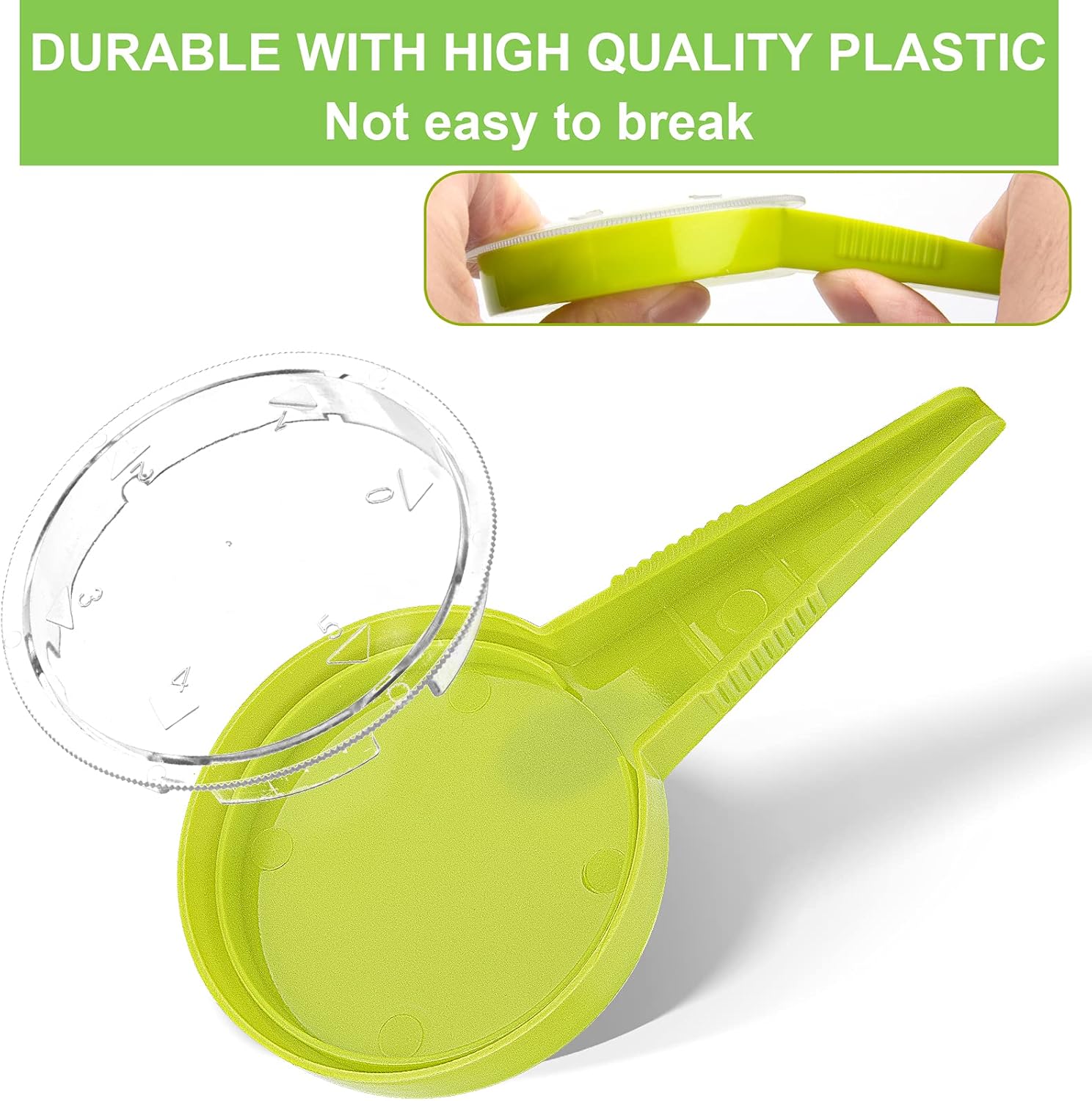
If you’ve ever tried to sow carrot seeds by pinching them between your fingers, you already know the problem: those seeds are tiny — roughly 1.5 to 2 millimeters across — and they have a talent for landing in clumps, gaps, or anywhere except where you actually wanted them. Lettuce seeds are barely bigger. When seeds pile up together, the resulting seedlings fight each other for root space, and you end up thinning out half of what you grew — wasted seed, wasted time, wasted bed space. A dial seeder (also called a tube seeder or adjustable seed sower) is a handheld plastic tool, usually $6–$15, that lets you rotate a dial to open or close a small gap at the seed-drop end. The idea is simple: you load seeds into a reservoir, set the gap to roughly match your seed size, tap or tilt the tube, and seeds fall out one at a time. For a beginner, it sounds like magic. For a grower who has actually used a few of these tools, the reality is more nuanced — and knowing which design actually works for carrots and lettuce will save you a frustrating season.
This guide draws on published product specifications, aggregated owner reviews, and editorial coverage from sources including the Johnny’s Selected Seeds equipment catalog and Growing for Market’s field-tool reporting to cut through the noise. We haven’t field-tested these tools ourselves; we’ve synthesized what consistent patterns show across the published record. Here’s what matters, what doesn’t, and which tube is worth your $10.
| EDITOR'S PICK[Coolrunner 6 Pack Sowing Seeds](https://www.amazon.com/dp/B07QPYTDB8?tag=greenflower20-20)… | Mid-tier4 Pack Adjustable Hand Hold Sow… | Budget pick[Ogrmar 5 PCS Seed Dispenser Sow](https://www.amazon.com/dp/B0775RBNDY?tag=greenflower20-20)… | |
|---|---|---|---|
| Seed adjust | ✓ | ✓ | — |
| Includes dibber | ✓ | ✓ | — |
| Includes widger | ✓ | ✓ | — |
| Qty in pack | 6 | 4 | 5 |
| Price | $8.99 | $6.20 | $5.99 |
| See on Amazon → | See on Amazon → | See on Amazon → |
Why “Dial Seeder” Is a Broad Label for Several Different Mechanisms
Walk into any garden center or browse a seed-supply catalog and you’ll see a half-dozen tools all marketed as “dial seeders” or “precision seed sowers.” The name covers at least three distinct internal mechanisms, and the mechanism determines whether the tool actually works for carrot- and lettuce-sized seeds.
Sliding-plate seeders use a flat plate with multiple holes of different sizes; you rotate the dial to slide the correct hole under the seed reservoir. Budget versions in this category — many in the $6–$9 range — tend to have loosely toleranced plates that allow multiple tiny seeds to slip through simultaneously. For large seeds like beans or squash, this is fine. For carrots (seed diameter roughly 1.5–2 mm) and lettuce (roughly 1–1.5 mm), the gap tolerances need to be tight, and inexpensive sliding-plate tools often aren’t.
Pinch-wheel or agitator seeders use a small rotating wheel or brush inside the reservoir to singulate seeds before dropping them. These are more reliably accurate for small seeds, but they’re also less common in the true sub-$15 bracket — most pinch-wheel designs start closer to $20–$30.
Vibrating or tap-drop tubes rely on gravity and gentle tapping; the dial simply sets the exit aperture. These are the most common truly cheap design. Their performance for small seeds depends almost entirely on how precisely the dial increments are calibrated and how cleanly the aperture closes between seeds.
Fine Gardening’s overview of seed-sowing tools notes that for seeds smaller than 2 mm, aperture consistency — not just aperture size — is the controlling variable. A dial that jumps from “too closed” to “two seeds” with no reliable sweet spot in between defeats the purpose entirely.
The Specific Problem with Carrots and Lettuce
Carrots and lettuce aren’t just small seeds; they’re also differently shaped, and shape matters for singulation.
Carrot seeds are irregularly oblong and slightly hairy on the surface — that surface texture causes them to cling together and feed inconsistently through narrow gaps. Pelleted carrot seed (where a clay coating rounds and enlarges each seed to roughly 3–4 mm) exists precisely to solve this problem for precision seeding, but pelleted seed costs significantly more per thousand seeds, and many home growers buy raw seed in bulk. If you’re using raw carrot seed, the dial seeder’s aperture needs to be set very close to 1.5–2 mm and the tool needs to be held at a consistent angle (roughly 30–45 degrees from vertical, based on manufacturer guidance across several brands) to prevent multi-seed drops.
Lettuce seeds are flatter and lighter — more like tiny slivers than spheres. They’re prone to static cling in dry conditions and to bridging (stacking sideways across the aperture instead of dropping through it). Aggregated owner reviews on garden-supply platforms consistently flag static as the biggest failure mode for budget dial seeders used with lettuce, particularly in low-humidity indoor seed-starting environments.
ATTRA’s market garden equipment notes recommend that for seeds under 2 mm, growers evaluate whether the seeder’s reservoir is enclosed (reducing static buildup) and whether the dial mechanism has tactile detents — audible or felt clicks at each setting — rather than a smooth continuous rotation, which is far harder to repeat accurately row to row.
By the Numbers
| Seed type | Avg. diameter (raw) | Target aperture setting | Common failure mode in budget dial seeders |
|---|---|---|---|
| Carrot (raw) | 1.5–2 mm | 1.5–2 mm | Multi-seed drop due to surface texture clumping |
| Lettuce | 1–1.5 mm | 1–1.2 mm | Static bridging; aperture too coarse at minimum setting |
| Radish | 3–4 mm | 3 mm | Generally reliable in most dial seeders |
| Beet (raw) | 3–5 mm | 3–4 mm | Generally reliable; corky seed clusters may double-drop |
Rodale Institute’s market garden equipment notes reinforce this pattern: radish and beet tend to be forgiving; carrot and lettuce are the stress test.
What to Actually Look For When Choosing a Sub-$15 Dial Seeder
Given that you can’t always get hands-on with these tools before buying, here’s the spec-sheet and review-pattern checklist that separates the reliable performers from the shelf-fillers.
1. Minimum aperture at or below 1 mm. This is the single most important spec. Many budget dial seeders advertise “five seed sizes” but their smallest setting is 2 mm — which will double-drop lettuce almost every time. Look for a stated minimum aperture of 0.5–1 mm. Johnny’s Selected Seeds’ equipment selector guide specifically calls out minimum aperture as the first filter when matching a seeder to small-seeded crops.
2. Detented dial positions. A dial with five or six distinct click-stops is repeatable. A smooth-rotation dial is not. When you’re sowing a 30-foot row of carrots, you need the setting to stay put.
3. Enclosed or near-enclosed reservoir. Open-top reservoirs expose seeds to airflow and static buildup. Enclosed designs with a small fill port are meaningfully better for lettuce. This is harder to determine from photos alone, but product listings that show the seed reservoir usually make it visible.
4. Tube length and grip ergonomics. Most dial seeders in this price range are 12–14 inches long — long enough to sow while standing, which matters if you’re doing any significant bed length. Shorter “pencil” style seeders (under 10 inches) require bending or kneeling and are better suited to seed-starting trays than open beds. Growing for Market’s field-tool coverage consistently flags stoop time as an underrated cost for small-farm operators; it applies equally to serious home growers.
5. What owners actually report for small seeds. Across aggregated reviews in gardening communities and catalog feedback, the tools that earn consistent praise for carrot and lettuce specifically — as opposed to general positive ratings driven by bean and squash users — tend to be the ones with the tightest minimum apertures and detented settings. Tools with mostly positive overall reviews but clusters of “doesn’t work for tiny seeds” feedback in the detail comments are almost always being rated well by users who sowed larger seeds.
The Honest Trade-Off: When a $10 Dial Seeder Is Enough and When It Isn’t
Here’s the decision frame:
If you’re sowing 50 feet or less of carrots or lettuce per season, a well-chosen sub-$15 dial seeder — one that passes the aperture and detent checklist above — is a completely reasonable tool. The per-seed savings on even moderately expensive carrot seed will recover the tool’s cost inside a single season. Fine Gardening’s tool overview notes that for home-scale beds, singulation doesn’t need to be perfect to be valuable; even dropping from “three seeds per spot” to “one or two” meaningfully reduces thinning labor.
If you’re sowing more than 100 feet per season, or if you’re working with expensive pelleted seed where every misfire is a real dollar cost, the dial seeder’s ergonomic and throughput limitations start to show. At that scale, Growing for Market’s coverage of precision seeding for small farms consistently points growers toward walk-behind push seeders — the Earthway 1001-B at roughly $130–$160 or the Jang JP-1 at roughly $300–$350 (2026 pricing) — as the tools where the economics genuinely flip. The per-unit cost is higher, but consistent in-row spacing, standing operation, and replaceable seed plates make the math work across a full growing season.
The upgrade signal to watch for: If you find yourself resowing the same rows because germination was uneven — not because the seed was bad, but because spacing was — that’s the dial seeder telling you it’s hit its ceiling.
The “If X, Then Y” Decision Rule
-
If you’re sowing carrots or lettuce in beds under 50 linear feet and using raw (non-pelleted) seed: buy a dial seeder with a stated minimum aperture under 1 mm and detented settings. Budget $10–$15. Recover cost in saved seed within one season.
-
If you’re sowing pelleted carrot or lettuce seed (which is pre-sized to 3–4 mm): almost any dial seeder works — the pellet solves the seed-size problem for you. Buy the cheapest one with reasonable build quality.
-
If you’re at 100+ feet of small-seeded crops per season, running a CSA share or cut-flower operation, or sowing multiple varieties with tight spacing specs: skip the dial seeder entirely. The Earthway 1001-B with the appropriate seed plate is the entry-level walk-behind that ATTRA and Growing for Market both treat as a standard reference tool for this scale, and the break-even math against thinning labor closes quickly.
-
If you’re experimenting with microgreens in trays: a dial seeder is awkward for broadcast-style sowing. Consider a dedicated shaker-style dispenser instead.
The dial seeder is a real tool — not a toy — when it’s matched to the right seed size and the right scale. The ones that actually singulate carrots and lettuce are a minority of what’s on shelves, but they exist, and the specs to look for are specific enough that you can find them before you buy.