April 12, 2026 • Maren Solvik • 9 min reading time • Specs verified June 11, 2026
Handheld Shaker Spreaders for Quick Broadcast Jobs: When a $10 Chapin Beats a $75 Push Spreader
If you’ve ever tried to scatter a cover crop mix, overseed a bare patch in a lawn, or broadcast clover between raised beds, you’ve probably reached for a handful of seed and just… flung it. It works, sort of. But you end up with bare spots next to clumps, and you’ve already used twice the seed you planned on. A broadcast spreader is any tool that disperses seed (or fertilizer) over a wide area rather than placing it in a neat row — it trades precision for speed and coverage. The two most common formats for home and small-farm use are the push spreader (a wheeled hopper you walk behind, typically $60–$120) and the handheld shaker spreader (a palm-sized or shoulder-bag unit you shake or crank by hand, typically $8–$30). This article is for the grower who already knows row-planting tools exist and is trying to decide which broadcast format is actually worth pulling off the shelf for the jobs that come up between the precision work.
The short answer: for areas under roughly a quarter-acre, and especially for irregularly shaped beds, paths, or the quick fill-ins that happen constantly in a working kitchen garden or small market plot, a handheld spreader regularly wins on time, cleanup, and cost — and the math is less obvious than most gear roundups admit.
What a Handheld Spreader Actually Is (and Isn’t)
The category spans a wide range of hardware, but they share one trait: you’re the engine. Seed lives in a small hopper — anywhere from a half-cup capacity on a basic shaker jar to roughly two pounds on a larger rotary hand spreader with a crank — and dispersal comes from shaking, tilting, or turning a crank that spins a small deflector plate.
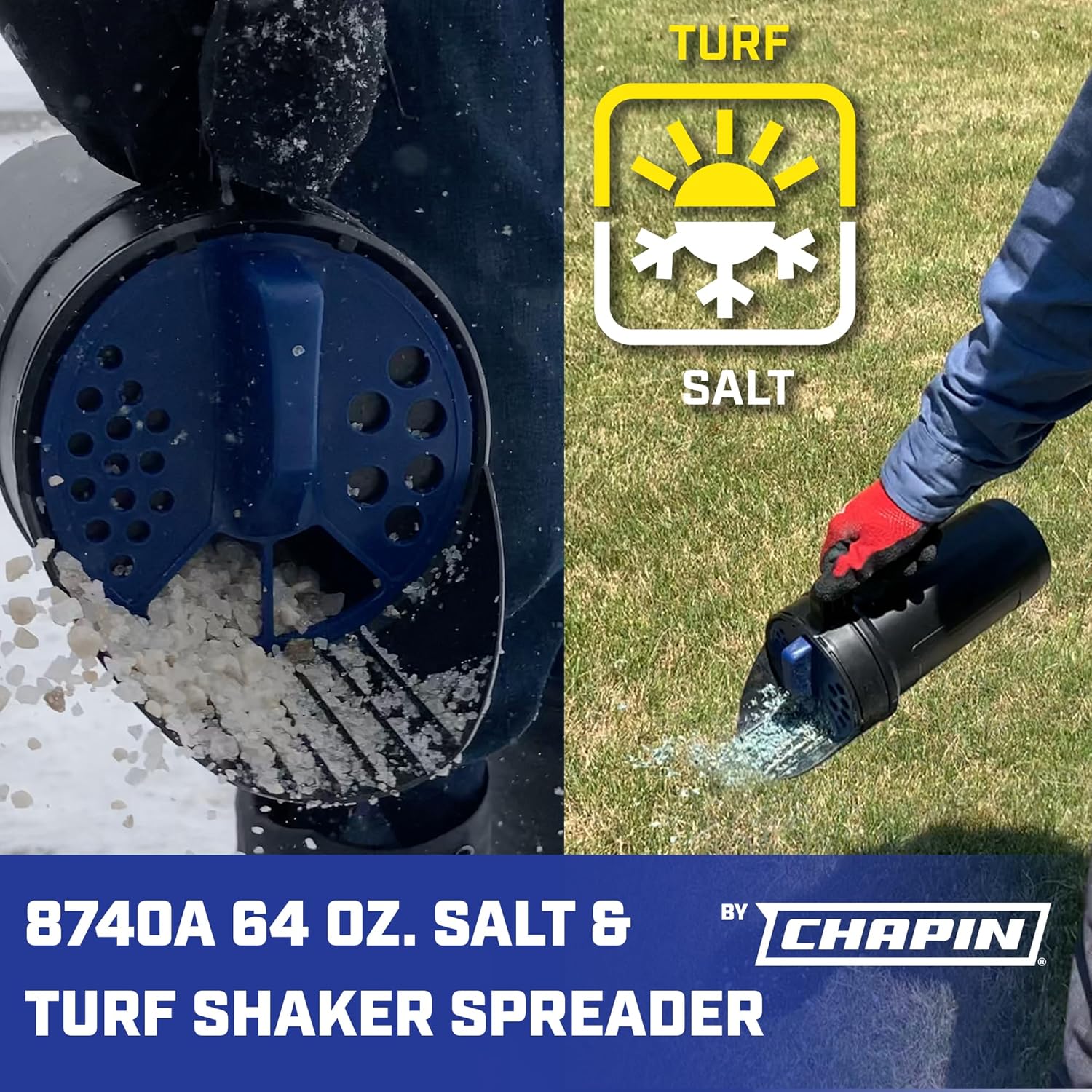
Shaker-style units (the Chapin 8701 is the most-referenced example in this category across aggregated retail reviews) are essentially a hard plastic jar with a perforated lid. You fill, you shake, you cover ground. No moving parts to break. Fine Gardening’s seed-sowing overview notes these are best matched to medium-to-large seed sizes — think clover, annual ryegrass, radish cover crops, or small-seeded wildflower mixes — where the hole pattern in the lid provides adequate metering without clogging on fine seed or letting chunky seed bridge and stick.
Rotary hand spreaders (the Scotts Wizz, the Earthway EV-N-SPRED, various unbranded units) add a hand crank that spins a small throw plate, giving you a slightly more consistent spread pattern and more range — typically 4 to 6 feet wide versus 2 to 3 feet for a simple shake-jar. They live in the $18–$35 range. Owners across multiple retailer review threads consistently flag the crank mechanism as the failure point after a season or two of fertilizer use (salt corrosion), but for dry seed they hold up well.
What neither format gives you: adjustable in-row spacing, seed singulation, or any real metering precision. If you need consistent 2-inch spacing on carrot seed or you’re running pelleted lettuce down a 200-foot bed, you’re in different territory — that’s a Jang JP-1 or a precision plate seeder conversation, not this one.
The Real Comparison: Handheld vs. Push Spreader by Job Type
The $75–$120 push spreader is a genuinely useful tool. On a half-acre lawn, it’s faster, more consistent, and less fatiguing than anything hand-operated. But market-garden and kitchen-garden growers consistently report — across forums aggregated by Growing for Market’s tool coverage and Johnny’s Selected Seeds’ seeding resource pages — that the push spreader spends most of its life in the corner of a shed, because the jobs that come up don’t match its format.
Here’s the core mismatch:
By the numbers — where each format fits:
| Scenario | Handheld Wins | Push Spreader Wins |
|---|---|---|
| Area covered | Under ~2,500 sq ft | Over ~5,000 sq ft |
| Bed shape | Irregular, curved, narrow | Rectangular, open |
| Setup + cleanup time | Under 3 minutes | 10–20 minutes with rinse |
| Seed quantity needed | Under 1 lb | Over 2–3 lbs |
| Portability / one-handed use | Yes | No |
The setup-and-cleanup number is the one that surprises growers who haven’t owned both. A push spreader needs to be calibrated — most units have an adjustable opening gate, and getting that setting dialed in for a specific seed size takes test runs. After use, especially with fertilizer or fine seed, the hopper and deflector plate need rinsing to prevent caking and corrosion. That 10–20 minute real-world cleanup cost is invisible in purchase decisions but very visible in practice. ATTRA’s small-farm production guide makes the same point about equipment overhead applying even to simple broadcast tools: the right scale of equipment is the one that gets used, not the one rated for a bigger job.
For the grower running a 30-bed CSA plot or a quarter-acre cut-flower field, the push spreader earns its keep on cover-crop establishment in the off-season. Rodale Institute’s cover crop establishment guidance specifically recommends push or tow-behind spreaders for anything over a tenth of an acre to achieve the even stand density that makes cover crops worth growing. Under that threshold, hand-broadcast or handheld rotary spreaders are listed as adequate for most cover crop mixes with seeds in the 1–4mm range.
Seed-Size Matching: Where Handheld Spreaders Have Real Limits
This is where precision-minded growers need to slow down, because the handheld category is not one-size-fits-all even within its niche.
Shaker-jar spreaders with fixed perforated lids are essentially calibrated at the factory for a seed size band. The Chapin 8701, for example, is referenced in aggregated retailer Q&A threads as working well for seeds roughly 2–5mm in diameter — clover, annual rye, mustard cover crops, small flower mixes. Below that range, you get inconsistent flow and potential clogging. Above it (think peas, beans, large brassica seed), seed bridges across the holes and you end up shaking hard to get anything out, which defeats the purpose.
Rotary hand spreaders with a crank-driven plate handle a slightly wider seed size range because the throw mechanism is less dependent on gravity, but the opening gate on most units doesn’t have fine enough adjustment for very small seed (sub-1mm). Fine Gardening’s seed-sowing overview notes that growers broadcasting lawn grass mixes — which often include seed down to 0.5mm — frequently get better results from a push spreader with a precision gate setting than from any handheld rotary unit.
The practical decision rule: if your seed is smaller than roughly 1.5mm or larger than roughly 6mm, test your specific unit with a small batch over paper before committing to a full bed. Seed is almost always the most expensive input in any given broadcast job, and losing a pound of pelleted wildflower seed to a clogged shaker lid is a real cost.
Break-Even Math: Is the $10 Tool Ever the Wrong Call?
For most kitchen-garden broadcast jobs, the handheld shaker is so cheap it essentially never fails a break-even test. At $8–$12, a single season’s use on cover crops alone — saving even a quarter-pound of over-broadcast seed through better distribution — pays it back. Johnny’s Selected Seeds’ seeding rate resources put cover crop mixes like crimson clover at roughly $6–$10 per pound (2025–2026 pricing band), meaning saving a half-pound of seed through slightly better distribution covers the tool cost in one use.
The question only gets interesting when you’re comparing a $25–$35 rotary hand spreader to a $75–$90 push spreader. Here the math turns on frequency and area:
- If you’re broadcasting cover crops or overseeding twice a year on beds totaling under 3,000 square feet, the rotary hand spreader wins on break-even and on the time-cost of setup and cleanup.
- If you’re broadcasting three or more times per season across more than 5,000 square feet — or if you’re also using the spreader for granular fertilizer on a larger plot — the push spreader reaches break-even in season two and pays a consistency dividend (more even distribution over wide areas) that compounds.
The grower who gets in trouble is the one who buys the push spreader for the two big cover-crop applications per year and then doesn’t use it for the fifteen small fill-in jobs because it’s too much hassle to pull out. ATTRA’s sustainable nursery production guide makes the broader point that equipment utilization rate matters more than unit capability when you’re working at small scale — the right tool is the one with the lowest friction for the jobs that actually come up.
The Decision Framework
If you’re sitting with this choice right now, here’s how to cut through it:
If your broadcast area is under 2,500 square feet and your seed is 1.5–6mm: A $10–$15 shaker-jar spreader is probably all you need. Buy the Chapin 8701 or a comparable unit, test the hole pattern against your specific seed before broadcasting a full bed, and put the savings toward better seed or a precision planter for your row work.
If your broadcast area is 2,500–10,000 square feet or you’re doing this more than three times per season: Step up to a $20–$35 rotary hand spreader. The wider throw pattern and adjustable gate earn back their cost in seed savings and time within a season or two.
If your broadcast area is consistently above a quarter-acre, or if you’re running a cover-crop rotation across a full market-garden plot: The push spreader earns its place. Budget for the cleanup time, get the calibration right for your specific seed mix (Rodale Institute’s cover crop guide includes seeding rate charts that help), and treat it as a genuine precision tool rather than a faster version of hand-scattering.
If you need both row precision and broadcast capability: Don’t try to make one tool do both jobs. Your Jang JP-1 or precision plate seeder handles the in-row work; a $15 shaker handles the broadcast fill-ins. The total outlay is under $30 for the broadcast side, which is less than the cost of a single pound of most specialty seed.
The push spreader is a good tool. It’s just not the default right answer for growers whose plots are measured in beds rather than acres — and for the quick broadcast jobs that show up constantly in a working garden, the $10 option that actually gets used is almost always the better piece of kit.