June 10, 2026 • Maren Solvik • 9 min reading time • Specs verified June 11, 2026
Spacing Templates and Dibbers for Raised Beds: Getting Square-Foot Grids Right Without Guessing
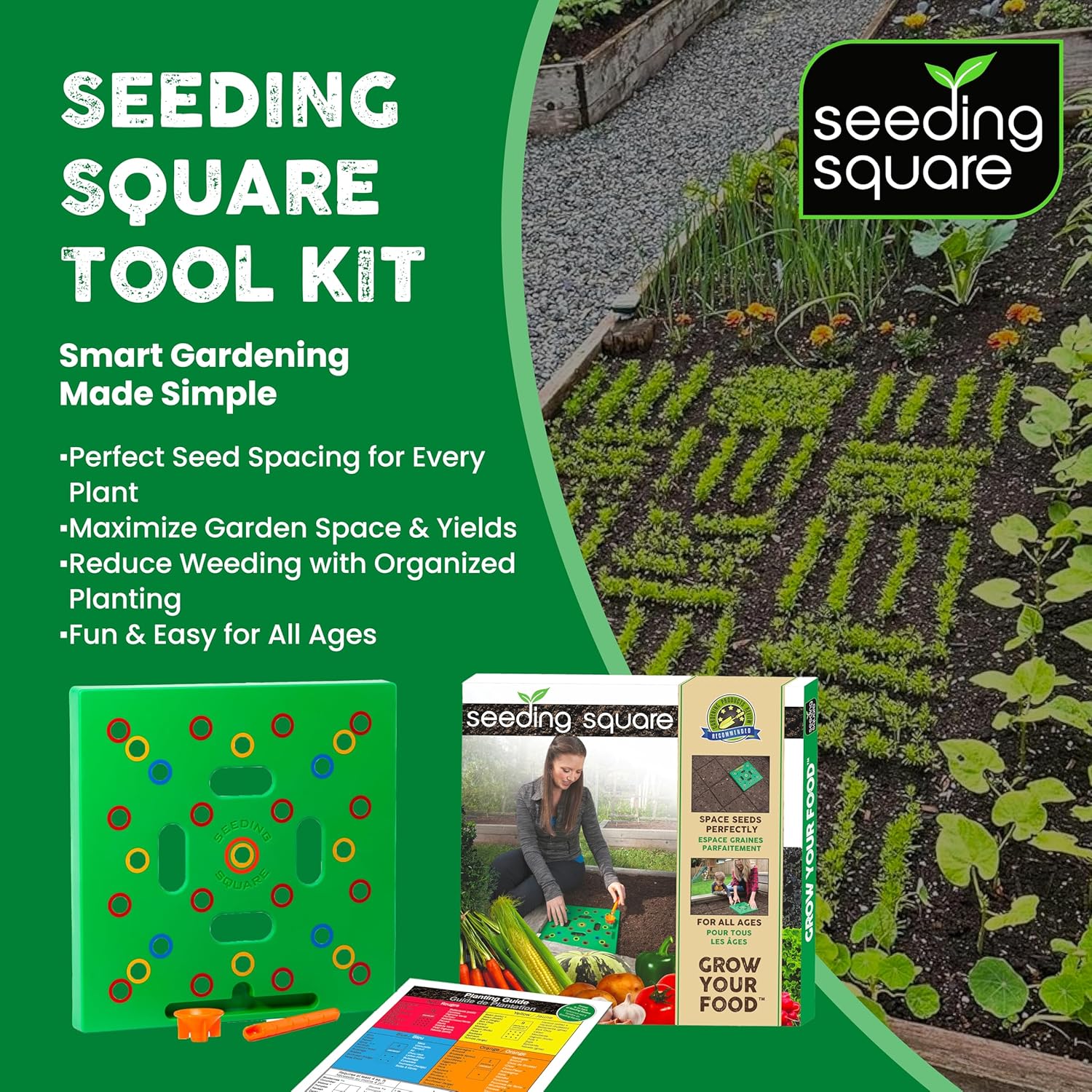
If you’ve ever finished planting a raised bed only to step back and realize your rows look more like abstract art than a grid, you’re not alone. “Spacing” in a raised bed means deciding exactly how far apart each seed or transplant sits from its neighbors — in both directions across the bed — so plants have enough room to grow without competing for light, water, or nutrients. Get it right, and you can fit significantly more food into a 4×8-foot bed than row gardening allows. Get it wrong, and you waste seeds, thin plants you didn’t need to sow, or end up with half your bed overcrowded and the other half bare. This article covers the practical tools that take the guesswork out of that layout: spacing templates (physical grids you press or drag across a bed), dibbers (pointed tools that punch evenly spaced holes), and the DIY versus buy math that determines which approach is actually worth your time and money.
Why “Eyeballing It” Starts Costing You at Scale
For a single 4×8 bed with tomatoes and peppers, imprecise spacing rarely matters enough to notice. But the moment you’re managing four or more beds — or working with expensive pelleted seed, germination-sensitive crops like carrots and parsnips, or transplants you’ve spent six weeks growing under lights — inconsistent spacing becomes a measurable loss.
The University of Minnesota Extension’s raised bed gardening guide makes the underlying math clear: a standard 4×4-foot intensive bed planted on a 6-inch grid holds 64 plant positions. Shift that grid by even an inch and a half off-center and you lose 8–12 positions around the edges — plants that crowd the frame or miss the bed entirely. At $0.15–$0.40 per pelleted lettuce or brassica seed (typical retail pricing from Johnny’s Selected Seeds for premium pelleted lines), that’s a small but real seed cost, and a larger opportunity cost in lost yield per square foot.
ATTRA’s brief on intensive planting systems notes that consistent in-bed spacing is one of the primary mechanical levers for yield-per-square-foot in a market-garden context — more reliably controllable, they argue, than fertility adjustments alone. That’s the frame for thinking about these tools: not a luxury, but a throughput input.
Spacing Templates: The Three Formats Worth Knowing
A spacing template is any rigid or semi-rigid guide you place on the bed surface to mark or press hole positions before seeding or transplanting. The category breaks into three practical formats.
1. Pressed-Grid Boards (DIY and Commercial)
The most common version is a flat board — typically 12×12 inches or the full width of a bed — with dowels, screws, or routed notches set at standard spacings (3, 4, 6, 9, or 12 inches). You press it into the soil surface, it leaves a grid of dimples, and you work your way down the bed.
Fine Gardening’s square-foot gardening coverage notes that many experienced growers build these from ¾-inch plywood with ⅜-inch hardwood dowels glued into a grid pattern, sanded flush on the pressing face. Total materials cost runs $8–$18 depending on lumber prices. The functional advantage over commercial versions: you can build exactly the spacings your crop mix requires, including non-standard intervals like 4.5 inches for dense beet plantings or a staggered 6-inch offset grid for maximum transplant density.
Commercial pressed-grid templates in the $20–$45 range (available from Lee Valley Tools and through Johnny’s Selected Seeds’ small-tools catalog) are typically injection-molded polypropylene in a 12×12-inch format. Published specs from Lee Valley’s tool listings put their grid board at about 11.5 inches square with 3-inch and 6-inch hole patterns molded in. Reviewers consistently note that the rigidity advantage over DIY boards is minimal unless you’re pressing into very firm, compacted soil — in a well-prepped raised bed with loose growing media, even a thin plywood DIY board presses cleanly.
The tradeoff: Commercial boards are instant and consistent out of the box. DIY boards require an afternoon but cost 40–60% less and can be made to arbitrary spacings. If your crop mix is standard (lettuce on 6-inch, spinach on 4-inch, brassica transplants on 12-inch), a commercial board covers most cases. If you grow a wider mix or use non-standard spacings from a crop plan, DIY earns back its build time within a single season.
2. Row-Marking Rakes and Dragged-Grid Tools
A row-marking rake has tines set at fixed intervals — typically 4, 6, or 12 inches — and is dragged along the bed length to score parallel seed furrows. This is the right tool for in-row spacing between rows, not within a square grid, which makes it a partial solution. Growing for Market’s feature on small-farm transplanting efficiency describes these as most useful for market gardeners who are direct-seeding in tight linear rows rather than using a strict square-foot grid.
For square-foot growers, the row-marking rake typically replaces step one (spacing rows) and a pressed-grid board handles step two (spacing within rows). Used in combination, you get a full two-axis grid without any additional measurement.
3. Full-Bed Grid Frames
These are wire or wooden frames sized to span the entire bed — most commonly built for 4-foot-wide beds — with string, wire, or rigid dividers creating visible squares at 12-inch intervals. The classic “Square Foot Gardening” method, documented in Mel Bartholomew’s original system and widely discussed in Fine Gardening, uses a permanent grid made from lath or twine stapled to a frame. The grid stays on the bed all season as a visual reference.
The limitation for serious growers: a 12-inch grid is too coarse for most intensive plantings. Lettuce, spinach, radishes, and beets all want 4–6-inch spacing, so a 12-inch grid works as a rough section marker but can’t guide individual plant positions within each square. Most practitioners who use grid frames add a pressed-board template for within-square positioning, or mark soil at finer intervals with a dibber.
Dibbers: When You Need the Hole, Not Just the Mark
A dibber (also spelled “dibble”) is a pointed or blunt-tipped tool used to punch a planting hole to a specific depth. Used with a spacing template, it converts grid marks into actual planting holes in a single step. Used freehand, it’s only as accurate as your eye.
The key spec that separates tool classes: depth markings. A quality dibber has clearly engraved or molded rings at ½-inch, 1-inch, 2-inch, and sometimes 3-inch depths, so you’re setting transplant roots at a consistent depth across the bed rather than guessing. Lee Valley’s stainless dibber line (ranging $18–$28 based on handle type) is frequently cited in aggregated reviews for legible depth markings and a comfortable T-handle that reduces wrist strain on repetitive planting. The ergonomic argument is real: planting a full 4×8 bed of transplants on a 6-inch grid means 128 hole-punches minimum. Wrist angle and grip diameter matter.
For market-garden operators planting flats of transplants daily, a longer-handled stand-up dibber — sometimes called a bulb planter when scaled up — reduces stoop time to near zero. ATTRA’s intensive planting brief specifically calls out stoop reduction as an underweighted efficiency factor in small-farm tool selection, noting that cumulative fatigue from bending affects not just comfort but accuracy in the back half of a planting session.
By the Numbers: Coverage Math for a Standard 4×8 Bed
| Spacing | Grid Positions (4×8 ft) | Annual seed cost at $0.25/seed | Savings vs. 25% waste (no template) |
|---|---|---|---|
| 4 in | 288 | $72.00 | ~$18.00 |
| 6 in | 128 | $32.00 | ~$8.00 |
| 9 in | 56 | $14.00 | ~$3.50 |
| 12 in | 32 | $8.00 | ~$2.00 |
Savings column assumes 25% seed waste from imprecise placement eliminated entirely — a conservative figure. Pelleted seed at premium pricing ($0.40–$0.60/seed) roughly doubles these figures.
DIY vs. Buy: The Honest Decision Frame
The break-even math for this category is simpler than for precision seeders or vacuum planters, because the tools are cheaper and the fabrication barrier is low. Here’s the clear “if X, then Y” framework:
If you grow one to two standard crops in standard spacings (lettuce, spinach, basic brassicas) in two or fewer beds: A commercial pressed-grid board at $20–$35 and a $20–$25 T-handle dibber is the complete toolkit. Total outlay: $40–$60, break-even within one season on saved pelleted seed alone at intensive planting densities.
If you grow a diverse mix including non-standard spacings, or manage four or more beds: Build a pressed-grid board to your exact spacings (afternoon, $10–$18 in materials) and buy the dibber — don’t DIY the dibber, because machined depth markings and a proper handle taper are genuinely hard to replicate with hardware-store dowel. Johnny’s Selected Seeds’ tool catalog and Lee Valley both stock quality dibbers that reviewers consistently recommend for durability over multiple seasons.
If you’re operating at market-garden scale (10+ beds, regular transplant volume): The tool that earns its cost most quickly is a stand-up dibber or a custom-length pressed board that spans your full bed width in one press, eliminating repositioning. Growing for Market notes that professional market gardeners often fabricate bed-width planting boards from their own lumber specifically to match their bed geometry — a 30-inch-wide bed gets a 30-inch board, eliminating repositioning overlap entirely.
If you’re considering skipping templates entirely and going straight to a precision seeder: Spacing templates and precision seeders solve different problems. A Jang JP-1 or Earthway 1001-B handles in-row seed dispensing and spacing along a furrow — it doesn’t grid a bed in two axes. For transplants and for crops like lettuce that benefit from a true square grid rather than linear rows, the template and dibber workflow remains the right tool regardless of what seeder you run. The two tools complement rather than replace each other.
Where to Actually Find These Tools
Retail availability for spacing templates is patchier than for seeders. Lee Valley Tools stocks the most consistent line of pressed-grid boards and dibbers in North America, with clear spec listings. Johnny’s Selected Seeds carries a small but well-curated selection oriented toward market-garden use. For full-bed grid frames, most serious growers report building their own, because commercial versions for beds wider than 12 inches are rarely stocked at retail. ATTRA’s intensive planting documentation includes construction dimensions for both lath-based and wire-based grid frames as a free downloadable reference — worth pulling before you buy lumber.
The bottom line: this is a low-cost, high-precision category where the right $30–$60 investment eliminates one of the most common sources of waste in raised-bed growing. The math is short, the tools are simple, and the upgrade path is clear.