May 16, 2026 • Maren Solvik • 9 min reading time • Specs verified June 11, 2026
Seed Starting Kits with Grow Lights: What the Spectrum and Timer Specs Mean for Your Vegetable Starts
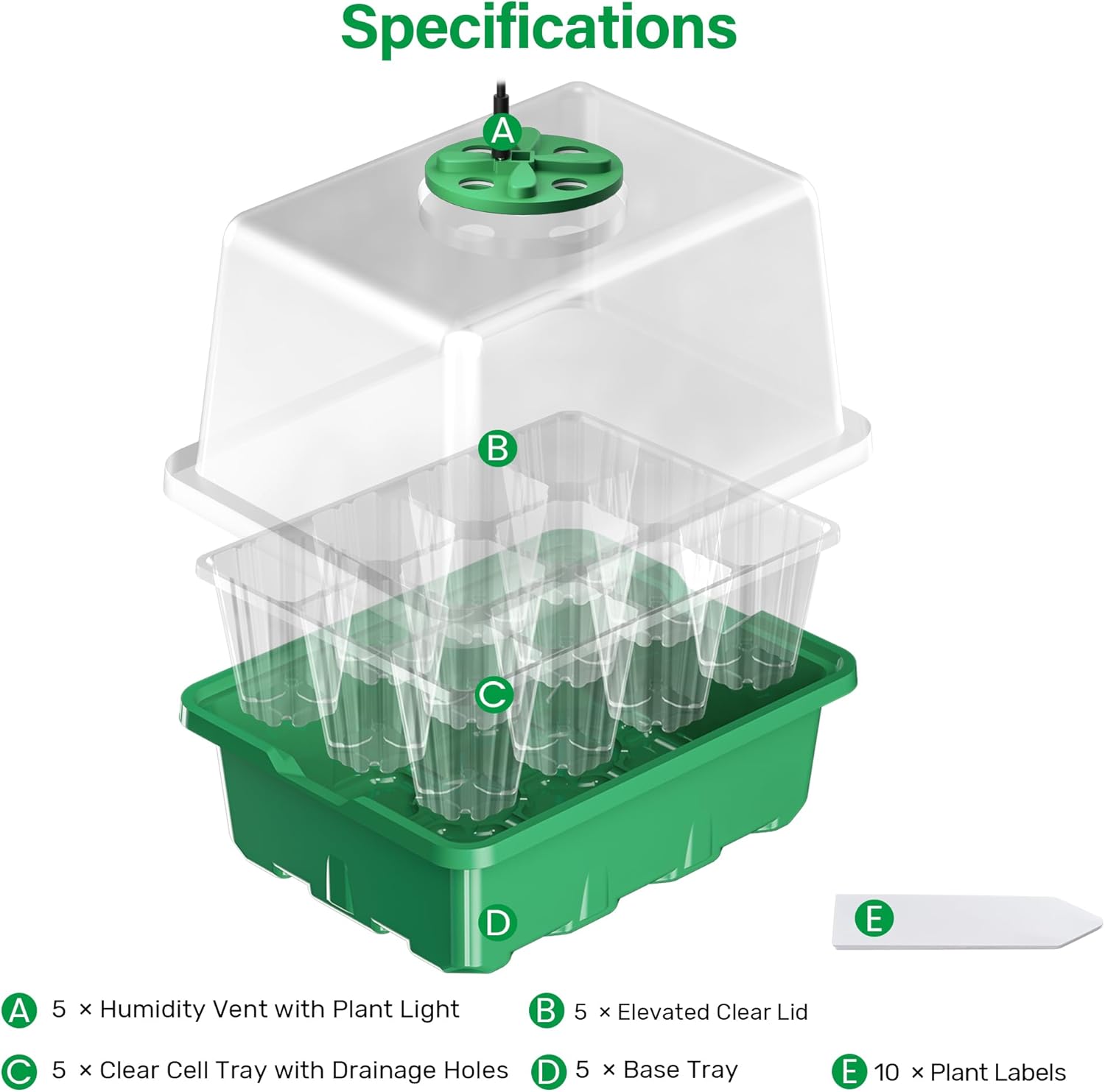
If you’ve ever watched a flat of tomato seedlings stretch toward a dim window, leaning at a forty-five-degree angle like they’re trying to escape — you’ve already learned the core lesson of indoor seed starting. Seedlings need light, and they need a lot more of it than most windowsills provide. A seed starting kit with a grow light bundles together a seedling tray (the shallow plastic flat you fill with germination mix), a humidity dome (the clear plastic cover that traps moisture during germination), and an artificial light source positioned directly overhead. The light replaces or supplements sunlight during the weeks before outdoor conditions are safe for young plants. The goal is a stocky, dark-green transplant — one with a thick stem and a strong root system — rather than a pale, leggy seedling that struggles after transplant. This article explains exactly what the light specifications on these kits actually mean for your vegetable starts, so you can compare products like a grower rather than a shopper.
| EDITOR'S PICK[Patigrow 120-Cell Self-Watering](https://www.amazon.com/dp/B0DQCVSYLD?tag=greenflower20-20)… | Mid-tier[Sondiko Seed Starter Tray with](https://www.amazon.com/dp/B0G6LCK1N2?tag=greenflower20-20)… | Budget pick[Bonviee 5 Packs Seed Starter Tr](https://www.amazon.com/dp/B08PFW3469?tag=greenflower20-20)… | |
|---|---|---|---|
| Cell Count | 120 | 80 | — |
| Pack Count | 1 | 2 | 5 |
| Light Feature | — | Adjustable Brightness | — |
| Spectrum | — | — | Full Spectrum |
| Price | $50.99 | $29.99 | $17.09 |
| See on Amazon → | See on Amazon → | See on Amazon → |
Why Spectrum Matters More Than Wattage (And What “Full Spectrum” Actually Means)
Walk through any online listing for a seed-starting grow light and you’ll see three terms repeated almost like a mantra: full spectrum, blue light, and red light. These aren’t marketing fluff — they map to real plant physiology — but they’re used so loosely that they’ve lost precision. Here’s the signal underneath the noise.
Photosynthetically Active Radiation (PAR) is the range of light wavelengths (400–700 nanometers) that plants use for photosynthesis. When a manufacturer says a light is “full spectrum,” they typically mean it emits wavelengths across most or all of that PAR range, plus sometimes a bit of near-ultraviolet and near-infrared on either end. The University of Minnesota Extension’s guidance on lighting for indoor plants confirms that for most vegetable seedlings, the most critical wavelengths are in two bands: blue (approximately 400–500 nm) and red (approximately 600–700 nm).
Here’s why each band matters for starts specifically:
-
Blue light (400–500 nm) governs compact, bushy growth. It suppresses stem elongation — the technical term for that unwanted stretching is etiolation — and promotes thick cell walls. For seedlings, blue-dominant light during the first two to three weeks is the primary defense against legginess. Fine Gardening’s coverage of grow lights for seed starting notes that blue-range output is the single most important spectrum variable for compact transplant production.
-
Red light (600–700 nm) drives photosynthesis efficiency and is critical for overall biomass production. A deficiency produces slow, pale growth even when blue light is adequate.
-
Far-red (700–800 nm) is a contested add-on for seed starting. It accelerates germination in some species by stimulating phytochrome receptors, but it also promotes stem elongation — the opposite of what you want once germination is complete. Growing for Market’s reporting on LED transplant production notes that commercial greenhouse operators routinely run far-red during germination and then switch to blue-heavy ratios once cotyledons open. Most consumer-grade kits don’t give you that control, which is worth knowing before paying a premium for “far-red enhanced” panels on a basic seed-starting rig.
The practical upshot: A light claiming “full spectrum” with a warm white color temperature (2700–3000K) skews red-heavy and is better suited to flowering and fruiting than to seedling production. For starts, look for fixtures rated at 4000–6500K color temperature, which skews blue-white. The Kelvin rating on consumer LEDs is an imperfect proxy for PAR distribution, but it’s the fastest filter you have when comparing kits at a glance.
Reading the Numbers: PPFD, DLI, and the Timer Math Your Seedlings Actually Need
Spectrum tells you the quality of light; PPFD and DLI tell you the quantity. These two metrics show up on higher-end kit specs and are increasingly appearing even on mid-range panels. Understanding them separates a calibrated purchasing decision from a guess.
PPFD (Photosynthetic Photon Flux Density) measures how many photons in the PAR range land on a square meter of surface per second. The unit is μmol/m²/s (micromoles per square meter per second). Think of it as the intensity of useful light at canopy level. The University of Minnesota Extension recommends PPFD values of roughly 100–200 μmol/m²/s for seedling production — enough to drive vigorous growth without the heat stress that higher intensities create at close range.
DLI (Daily Light Integral) is the total amount of PAR light delivered over a full day. It’s calculated as: PPFD × photoperiod (hours) × 3.6 ÷ 1000. For most warm-season vegetable starts — tomatoes, peppers, cucumbers — a DLI of 10–16 mol/m²/day supports strong seedling development, per UC Davis Cooperative Extension guidance on transplant production.
By the Numbers: Timer Settings for Common Vegetable Starts
| Crop | Target DLI (mol/m²/day) | Hours at 150 μmol/m²/s |
|---|---|---|
| Tomatoes / Peppers | 12–16 | 22–30 hrs (split across 16 hrs max) |
| Brassicas (cabbage, broccoli) | 10–14 | 18–26 hrs equivalent |
| Lettuce / Spinach | 8–12 | 15–22 hrs equivalent |
| Basil | 12–15 | 22–28 hrs equivalent |
Note: No vegetable seedling benefits from 24-hour continuous light. Darkness triggers root development and cellular repair. Cap photoperiod at 16–18 hours maximum.
This is where the timer spec on your kit matters operationally. A kit with a fixed 16-hour timer is not a deficiency — 16 hours is close to optimal for most warm-season starts. But a kit that only offers an 8- or 12-hour fixed cycle will underdeliver DLI for tomatoes and peppers unless your PPFD is unusually high. The math is straightforward: if your panel delivers 100 μmol/m²/s (common for entry-level T5 fluorescent or budget LED strips) at 12 hours, your DLI is approximately 4.3 mol/m²/day — well below the threshold for tomatoes. Owners of lower-intensity kits consistently report better results when they add a separate outlet timer and extend the photoperiod to 16 hours rather than relying on the fixture’s default cycle.
Kit Configurations: Matching the Hardware to Your Production Scale
Consumer seed-starting kits with integrated lights currently fall into three functional tiers, each with a distinct tradeoff profile.
Entry-level clip-on and strip kits ($30–$80): These typically pair a single 1020 propagation tray (standard 10” × 20” flat) with one or two LED strip bars or a small T5 fluorescent tube. Rodale Institute’s seed-starting guidance recommends this format for home gardeners running one to three flats per season. The limitation isn’t the tray — it’s that single-strip fixtures often deliver adequate PPFD only in the center of the flat, dropping off significantly at the edges. Growers running brassica starts in a 72-cell flat consistently report edge-cell seedlings that are visibly less developed than center cells under these rigs.
Mid-range stackable shelving kits ($90–$200): The more useful format for anyone growing 3–8 flats per cycle. These pair wire shelving with 2–4 foot T5 HO (High Output) or full-panel LED bars per shelf. Johnny’s Selected Seeds’ transplant resource center specifically recommends T5 HO fixtures at 2–4 inches above the canopy for commercial-quality transplant production, noting that maintaining consistent fixture-to-canopy height as seedlings grow is as important as the fixture spec itself. The stackable format’s real advantage is vertical density — you can run tomatoes, lettuce, and brassicas at different shelf heights and adjust spacing without buying separate rigs.
Dedicated LED panel kits ($180–$400+): Targeted at market-garden operators and serious home growers who want PPFD uniformity across the full flat and programmable spectrum or timer control. Growing for Market’s LED transplant production reporting documents that farms running 20+ flats per cycle have shifted toward Samsung LM301-series diode panels for their combination of efficiency (high PPFD per watt) and longevity. At this tier, the fixture is typically purchased separately from trays and shelving — you’re not buying a “kit” so much as building a transplant system.
The Timer Spec Decision: Fixed Cycle vs. Programmable
Most kits under $120 ship with one of two timer configurations: a fixed photoperiod (commonly 16/8 on/off) or a simple manual outlet plug that requires a separate timer. A small but growing number of mid-range kits include programmable cycle timers with 30-minute increment control.
For dedicated vegetable starts, the tradeoff is this:
- Fixed 16-hour cycles work well for tomatoes, peppers, and most warm-season crops. They’re one less variable to manage, and the spec matches published DLI targets at moderate PPFD levels.
- Programmable timers justify their cost premium only if you’re running mixed species with different DLI requirements on the same shelf, or if you want to experiment with far-red stimulation during germination (lights on 18+ hours) and then dial back to 14 hours for grow-out. Small-scale cut-flower producers starting ranunculus or anemone alongside tomato transplants — two crops with meaningfully different light requirements — are the clearest use case.
- Manual plug setups are the worst default outcome: owners report that without a dedicated outlet timer, the lights run on inconsistent schedules and results suffer. Budget $10–$15 for a mechanical outlet timer if your kit doesn’t include one.
Decision Rules: If X, Then Y
After synthesizing published specs, manufacturer guidance from Johnny’s Selected Seeds and comparable suppliers, and the agronomic thresholds documented by UMN Extension and UC Davis, the decision framework is straightforward:
If you’re starting 1–3 flats of mixed vegetables per season at home: A mid-range LED strip kit with a 4000–6500K color temperature, a 16-hour timer, and a listed PPFD of at least 100 μmol/m²/s at the tray surface covers your needs. Don’t pay extra for programmable spectrum control at this scale.
If you’re running 4–10 flats per cycle for a CSA, market garden, or intensive home production: Move to a stackable T5 HO or full-panel LED system with verified PPFD uniformity across the full flat. The per-flat cost difference between entry-level and mid-range hardware is recovered in reduced re-sowing of uneven flats within two to three seasons.
If you’re growing light-hungry crops (tomatoes, peppers, basil) and your starts are consistently leggy: Before buying a new fixture, calculate your current DLI. Extend your photoperiod to 16 hours. If that doesn’t resolve etiolation, your PPFD is the limiting factor — lower the fixture height to 2–3 inches above the canopy, or upgrade to a higher-output panel.
If far-red or programmable spectrum is being marketed as a key feature: It’s a meaningful variable only if you have a documented germination protocol that uses it, or if you’re growing crops with specific phytochrome requirements. For standard vegetable transplant production, consistent PPFD and a correct photoperiod outperform exotic spectrum manipulation every time.
The light spec that matters most for your vegetable starts isn’t the one with the most bullet points on the listing — it’s the one that delivers the right DLI, at the right color temperature, to all the cells in your flat, consistently, for 6–10 weeks per season. Match those numbers to your crop list and your scale, and the kit decision becomes considerably less complicated.